Behind the 8.5-million-player city is one developer with a Chromebook. The Lagos Life origin story has become part of the game’s mythology — here are the facts as reported, separated from the claims. For what changed in the game itself this month, see the update tracker.
Who created Lagos Life?
Shalom Rayhamen, a Nigerian software developer who goes by Eliy online (@Shalom_HeyEliy on X) — the founder, the creator and the developer are all the same person. She is 26, grew up in Port Harcourt and wrote the first version of the game on a Chromebook her mother gave her, per Zikoko’s profile. The official live stats page credits her by name, and the game’s terms list her as the operator. The official account @LagosLifeApp announces features in her voice, often with the developer’s own follow-up posts explaining what shipped and why.

Shalom Rayhamen, founder of Lagos Life. Portrait via her public social profiles, as published in Zikoko’s profile.
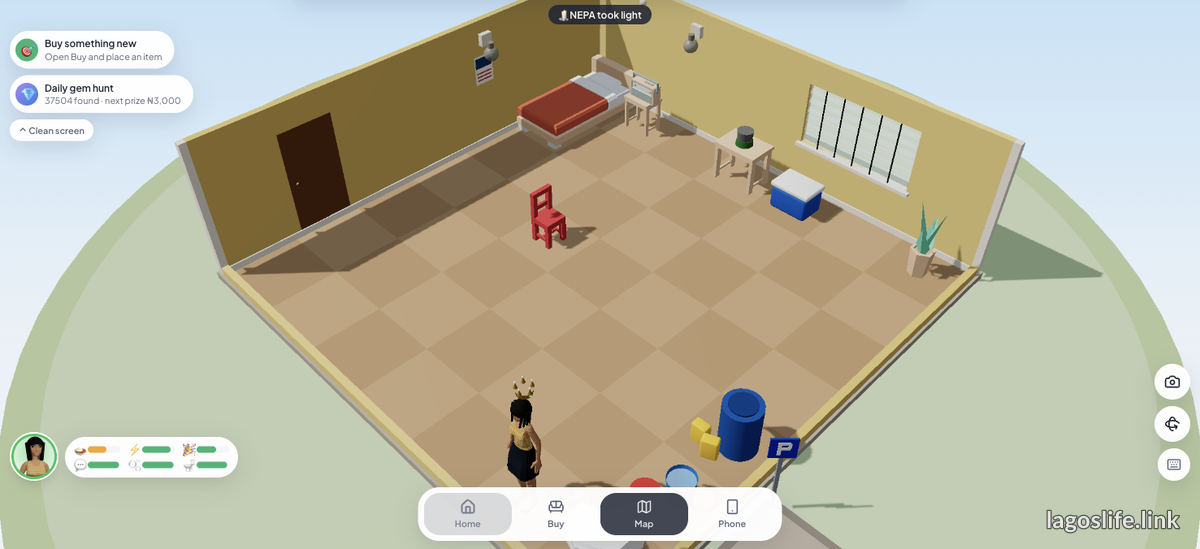
The eight-hour core grew into this — a persistent home you furnish, a Sim with moods and skills, all running live in a browser tab:
How long did it take to build?
A Zikoko profile reports the first version took about eight hours to build — started on a Wednesday night for fun, finished around 5 a.m. on 1 October 2026 (Nigeria’s Independence Day), with the link posted on X at 7 a.m. and ten thousand plays by mid-morning. “All I know is I started building a game for fun on a Wednesday night,” she told Zikoko, describing a Sims-inspired build prompted by a Danfo driving game trending on her timeline. That eight-hour core explains the shape of the launch: a small, sharp game (live in a browser, free, instantly social) that went viral before most features existed. Everything layered on since — the third city, courts, CBN elections, the phone app ecosystem — came through near-daily updates after launch, which our tracker logs.
How fast did it grow?
The first week set the pace: Zikoko reported 1 million players inside seven days (7 October), and tech reviewer Fisayo Fosudo’s interview with the creator puts 1 million sign-ups inside three days. By the numbers on the official stats page (checked 11 October 2026):
| Milestone | Figure |
|---|---|
| Total players | 8,597,891 |
| Active yesterday | 1,542,312 |
| Visits all time | 37,923,834 |
| Launch date | 1 October 2026 |
Ten days, 8.5 million players, no download required. The player-driven politics layer — where a CBN election drew 493,067 votes — is the clearest sign the population is engaged, not just registered.
What is Lagos Life worth?
The figures in circulation, with their sources:
- $500,000 pre-seed at a $10 million valuation — reported by Techpoint Africa on 9 October, in the launch window. This is the only funding figure with a named source and a date.
- Rejected $100,000 buyout — reported by both Vanguard and Zikoko. Zikoko adds that her disclosed earnings at the time were over $46,000, and quotes her reasoning: “How can I sell a business that is projected to earn $50m before December?”
- $1 billion valuation — the creator’s own claim, as reported by Vanguard. Treat it as a founder’s statement, not an audited number.
What the money story cannot inflate is the usage data — and that part is public on the stats page.
How does a free game make money?
The same way the open web always has: optional Naira top-ups (the currency is in-game only and cannot be withdrawn — see what is Lagos Life) and advertising. Zikoko’s profile details the mix: Naira bundles from ₦500 to ₦2,000 (later ₦10,000 and ₦20,000) made roughly ₦150,000–₦200,000 in the first three days, while virtual billboards became the most profitable surface. The ad layer is real money, not in-game Naira: a main-road digital board books at ₦250,000 for 7 days (about $175) through a Flutterwave checkout, and TechCabal counted 244 ads across 40 locations worth about $46,900 in the second week — see billboards and sea plots and the economy timeline. There is no subscription and no pay-to-win gate on careers or elections.
Where do I follow the founder and the story?
The founder:
- X (personal) — @Shalom_HeyEliy, where she posts build notes and follow-ups in her own words
- X (official game) — @LagosLifeApp; TikTok, Instagram and LinkedIn are all linked from lagoslife.app
The long-form interviews:
- Zikoko: “Lagos Life is Going to Retire Me” — the full life story, 7 October
- Fisayo Fosudo’s video interview — the 1-million-in-3-days claim
- The African Engineer: The Engineering Behind Lagos Life — the technical build story
- The Guardian: Inside Lagos Life — the virtual-Nigerian-economy angle, mid-October
For in-game changes (court reform, elections, new venues), the update tracker mirrors official announcements with dates.