The Lagos Life Economy Explained: Naira, Taxes, Banks and Ads
How the Lagos Life economy works: a locked naira, published rules, banded income tax, real-money billboards and open developer APIs — mapped layer by layer.
Press coverage now calls Lagos Life a virtual Nigerian economy. That is a big phrase, so this page does something stricter: it maps the economy layer by layer — currency, state, private assets, advertising, platform — and attaches a source or an in-game test to every number. For the basics of the game itself, start with what is Lagos Life; for earning step by step, the money-making guide is the operational manual.
One currency, two very different wallets
The in-game Naira is a closed loop. You earn it from career shifts, side gigs and hustle missions; the game’s terms state it has no real-world value and cannot be withdrawn. Buying Naira is a purchase, not an investment, and anyone offering Naira “returns” in chat is running a scam — see the scams guide.
Real currency touches the economy through exactly two doors, and both point inward: top-up bundles (₦500–₦2,000 at launch, ₦10,000 and ₦20,000 later, per the creator’s Zikoko interview) and the advertising checkout below. That asymmetry — a simulated economy you can put real money into but never take money out of — is the core design decision everything else sits on.
The state layer: a rulebook you can actually read
Most games hide their economy math. Lagos Life publishes it on an official policy endpoint, which this wiki snapshots and diffs in the policy history tool. The levers it exposes:
- Taxes — banded income tax above a ₦1,000,000 weekly allowance. The bands briefly took 20%, 30% and 35% after the 17 October policy flip (a flat 7.5% held from the 12 October reset until then), before an unannounced overnight rewrite on 20 October cut every band to 7%; how the bands hit real payslips is still being verified. Whale clauses now also sit at 7% above ₦1 trillion net worth, their price multipliers cut from 10×/50×/100× to 1×/1×/3×.
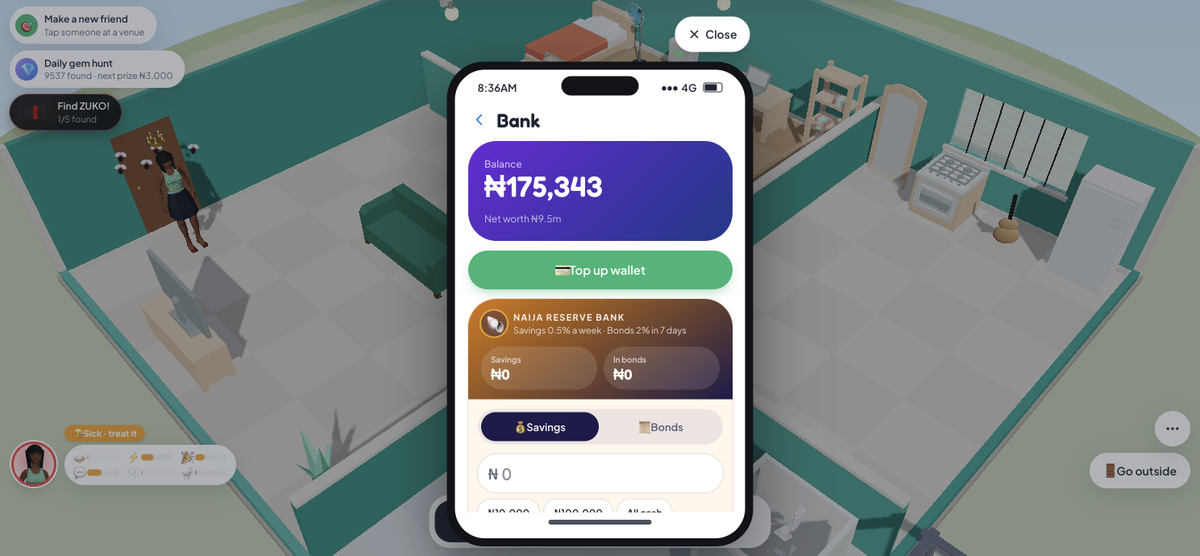
- Interest rates — the Bank app pays 0.5% a week on savings and 2% per 7 days on Reserve Bonds (₦10,000 minimum, ₦500m cap), and its fine print says the Naija Reserve Bank sets the rates.
- Elected policy — the CBN governor election drew 493,067 votes, and the winner’s weekly laws move real prices: the first agenda halved danfo and keke fares for a week. See the elections guide.
The private layer: what Naira buys
Three asset classes sit on top of the state layer, all tested in-game:
Land — quarter plots from ₦250,000 in Ikorodu to a ₦2,500,000 full plot in Epe, yielding 2.5–3.8% a week, every listing tagged with an “omo-onile risk” nod to Lagos’s real land disputes.
Businesses — six verified tiers from a ₦300,000 zobo stand (₦1,800–₦5,800 a day) to a 5% Quilox share at ₦250,000,000 (₦645,000–₦2,400,000 a day), with variable daily income.
Homes — the rental ladder starts at ₦1,200 a week, and the landlord path turns property into yield: our ₦26,000 invest-room test pays back in about 89 days at the quoted occupancy. The full math, plus what a flood does to an uninsured Lekki home (₦16,500, in our test), is in the real estate guide.
Geography prices risk, the way it does in the real Lagos: river-adjacent districts flood, insurance is sold in the Assurance app, and commute distance taxes every shift — the city map guide breaks the districts down.
The ad economy: real money inside the game
The advertising layer runs on real currency through Flutterwave — naira or dollars, not your in-game wallet:
| Ad product | Price (7 days) | What you get |
|---|---|---|
| Digital board, main roads | ₦250,000 (≈$175) | 15-second slot in a ~30-ad rotation |
| Sea Plot, the lagoon | ₦500 per plot (≈$0.35) | Your own patch, any size |
Tapping a running ad opens a leave-the-game interstitial, then the advertiser’s real website. TechCabal counted 244 ads across 40 locations worth about $46,900 in the game’s second week, and the creator’s own Zikoko interview calls billboards her most profitable surface, alongside promoted music in virtual clubs. How to book both products, with screenshots: billboards and sea plots; the live board inventory is mirrored in our billboard database table.
An economy built in public
Week one was turbulence: a launch-day outage, a minting exploit that ballooned balances, a bug that wiped fortunes, and a wholesale policy reset on 12 October. The creator has since confirmed the wipe herself — “I accidentally wiped out everyone’s money.” The whole dated chain, with source quality per entry, is in the economy timeline. The structural takeaway is that the economy’s parameters now move centrally and publicly, which is what makes a page like this one possible.
The platform play: the economy as an API
The economy is also exposed to the outside world. The policy feed, the billboard inventory and the daily treasure hunt all have public endpoints this wiki reads directly, and The Guardian reports the studio has announced APIs and SDKs so other developers can build on the game — the “virtual Nigerian economy” pitch in one sentence: the economy is the product, and the game is its interface.
Related Articles
Lagos Life's Third-Party Games: the VATAR Platform, Live Today
Lagos Life opened its gates to other developers: Naija Farmer, Landlord and Maruwa Drive are live on the official platform — what is on it and how it works.
Do Lagos Life Codes Exist? The Honest Answer (October 2026)
No Lagos Life redeem codes exist — the game has no code system at all. Why every 'active codes' list is fake, how the scam works, and what to earn instead.
Is There an Official Lagos Life App? Download Status & Lookalikes
There is no official Lagos Life app yet: the game runs only in your browser at lagoslife.app. App-store status, the safe PWA install, and every lookalike to avoid.
Related data & tools
FAQ
Is the money in Lagos Life real money?
Who controls the Lagos Life economy?
How does Lagos Life make money from its economy?
Can the Lagos Life economy crash?
Was this helpful?
Thanks for the feedback!